|
|
|||||||||
|
||||||||||
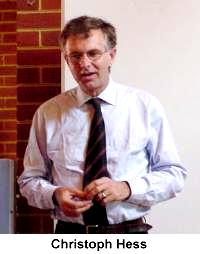
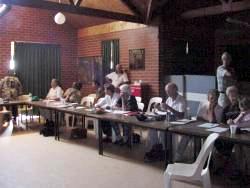
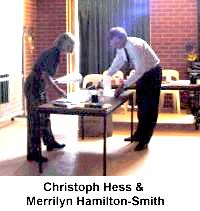
Werribee Park Equestrian Centre The Equestrian Federation of Australia (Victorian Branch) was able to extended an invitation to the many Australian dressage judges who were in Melbourne for 'Dressage with the Stars' to listen to one of the world's leading authorities on dressage riding judging and in particular the development of the sport in young horse classes.
His qualifications include a Degree in Education, majoring in the education of adults. He is an International Dressage Judge and Three Day Event Judge and Berufsreitlehrer (FN), and a high level riding trainer. Christoph has been employed by the German Equestrian Federation since 1978 and spends much o his time conducting seminars and clinics for judges, trainers and riders in Germany and abroad.
Meeting Agenda
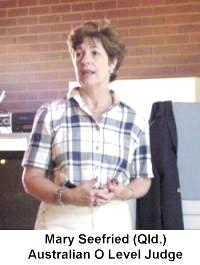
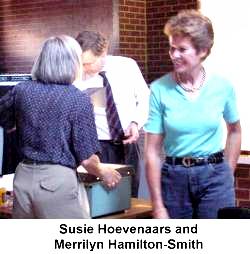
Present : Karin Davis (Vic), Veronica Blanks (Vic), Robert Hammond (Vic), Wanda Nelson (Vic), Merrilyn Hamilton-Smith (Vic), Carolyn Lieutenant (NSW), Judy Cubitt (NSW), Joanne Fowler (WA), Roz Tippett (WA) Berni Saunders (Vic), M Kelly (Vic), Mary Hovers (SA), Kerry Grivell (SA), Jane Bush (SA), Ron Patterson (Qld), Malcolm Barnes(Vic), Susie Hoevenaars (Vic), Irene Bakels-Noreen (Qld), Jane Grant (Vic), Helen Heagney (Vic), Marie Gahan (Vic), Mary Seefried (Qld), Caroline Coleby (Vic), and Jan Smith (Vic).
We were told that since the retirement of Klaus Balkenhol as the German National Coach, this position is now filled by Holger Schmitzer - formerly the trainer of the German Junior riders squad. He felt that our system could be facilitated by producing a regular newletter specifically for dressage Judges - like the International Judges association, but covering local issues and directives, some of which will come from the FEI. He made special mention of the quality of information available to us by experts like Dr. Helen Davies, the Veterinarian from Melbourne University Clinic at Werribee, who is known for her input at most of our big competitions. He thought that her notes were particularly relevant and valuable for dressage judges (see Public Arena).
At German shows (of the Olympic disciplines) 10% of horses are checked by a vet. This involves a thorough check with saddle off. The horse's back, legs mouth etc, were inspected as part of this fitness check. In Germany, all prospective Dressage Judges must be a recognised Silver Medal rider - having achieved 65% at Prix St. George. From here, there is an opportunity to go on for a further two years training to specialise in the judging of dressage specific to the horse, and specific to the rider. To judge FEI dressage, one must be a Gold Medal rider and have a trainers qualification, in order to be eligible to apply to sit for judges exams. As it is in Australia, all German dressage judges must re-accredit every 2 years.
Christoph moved to the special considerations of judging Young Horses. He mentioned a "Suitability Dressage Test" the 5YO FEI Dressage and the 6 YO FEI Dressage Test, to be ridden in a snaffle. These tests are judged on rideability and basic paces, general impression and suitability as a dressage horse. Errors of course are penalised as in dressage tests. Rider errors are not taken so much into account. The tests are created to suit the level of transitions of a young horse, "Does the horse's performance correspond with the general idea of a dressage horse - is the horse on the right track with his schooling?" After some minor technical problems (no one knew how to work the VCR) we were treated to Christoph's own narration and explanation of his video on Dressage judging. In this tape he takes a look at the German system of judging and makes comments on the organisational aspects of running a dressage competition. The German system sees the Preliminary and Novice tests being judged with 4 horses in the arena at one time. He stressed that the judges sit together, and discuss the mark which is out of 10 for the whole test. Working notes, based on the conventional method of judging - a mark per movement - are kept, but only one mark is awarded at the end of the test, and the competitor has the chance to come and talk to the judges as soon as the test is finished. Most judges in the room agreed
that this system would work well and streamline the functioning of competition days,
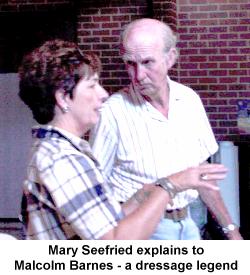
allowing for many more horses at the lower levels to take part. Malcolm Barnes has
been in favour of Australia adopting this system, for many years. Maybe he will see it
happen now that it has been sanctioned by Christoph commented of his experience judging the Bates 2000 Australian Young Dressage Horse Championships over the weekend. "Many horses were not prepared in accordance with the judges requirements. Only 4 horses in the 6 year old class were able to perform a flying change. Riders did not understand the requirements of give the rein a few strides and trot on a loose rein"
We were told that, when the test specifically asked for a flying change and a simple change was ridden, 5.9 was the MAXIMUM score that could be given. This is based on 5 - sufficient and 6 satisfactory (which could not be awarded).
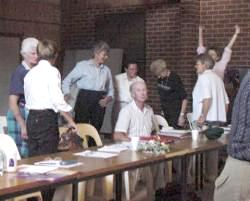
The room was 'buzzing' with enthusiasm for how the regional clubs and state branches may be able to introduce such classes into their dressage competition calendar. After question time and the session conclusion, our representatives stayed back to discuss where we may begin !
Thankyou Go to 2000 Australian Young Dressage Horse Championships - Berni Saunders Report |
||||||||||




 is currently the Director of Training for the German
Olympic Committee for Equestrian Sports (DOKR), he brings
is currently the Director of Training for the German
Olympic Committee for Equestrian Sports (DOKR), he brings 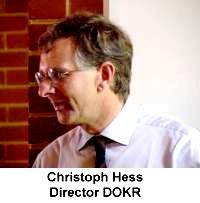 a wealth of
judging and training experience to this group of Australian who are key people,
involved in progressing the sport in their home state.
a wealth of
judging and training experience to this group of Australian who are key people,
involved in progressing the sport in their home state.